CBAM from February 2027: What Buyers of Steel, Aluminium and Cement Need to Settle Now
CBAM certificates go on sale on 1 February 2027, and importers must surrender them for their 2026 imports by 30 September 2027. Buyers without real emissions data from their suppliers will pay on default values with mark-ups.
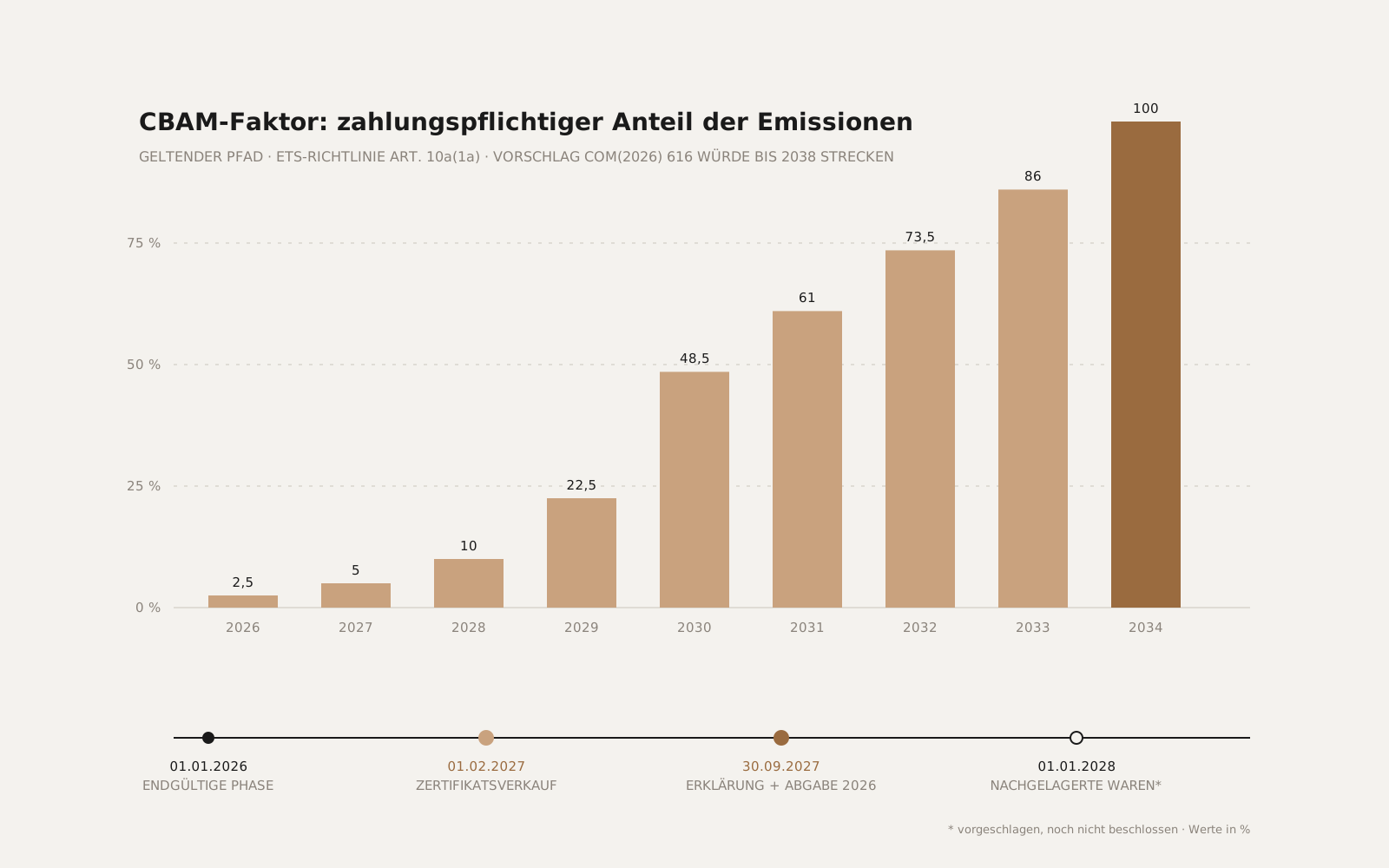
The EU's carbon border adjustment (CBAM) is about to cost money. According to the German Emissions Trading Authority (DEHSt), sales of CBAM certificates to authorised declarants start on 1 February 2027. By 30 September 2027, declarants must file their first annual declaration for 2026 imports and surrender the matching certificates. For buyers of steel, aluminium, cement and fertilisers, the size of the bill is being decided now: by the quality of their suppliers' emissions data.
What has applied since January 2026?
The definitive phase of CBAM began on 1 January 2026. Anyone importing more than 50 tonnes of CBAM goods a year needs authorised CBAM declarant status. The threshold applies cumulatively to iron and steel, aluminium, fertilisers and cement. Once it is exceeded, all imports of that year fall under CBAM, not only the part above 50 tonnes. According to the Commission, the threshold exempts about 90 percent of importers while still covering 99 percent of imported emissions. Hydrogen and electricity are not covered by the exemption.
What does a certificate cost?
For 2026 imports, the price follows the average EU ETS auction price of the quarter in which the goods were imported. From 2027, the Commission publishes the price weekly. Also from 2027, declarants must hold certificates for at least 50 percent of the emissions imported so far at the end of each quarter.
How much is actually payable depends on the CBAM factor, which mirrors the phase-out of free allocation in the EU ETS. It is 2.5 percent of embedded emissions in 2026, 5 percent in 2027 and 48.5 percent in 2030, reaching 100 percent in 2034. On 17 July 2026 the Commission proposed stretching the phase-out to finish only in 2038. That is a proposal, not yet law.
Why does real supplier data matter so much?
Without verified emissions data from the producing plants, importers must use default values. These carry a mark-up: 10 percent for 2026, 20 percent for 2027 and 30 percent from 2028. The default values themselves were corrected in July 2026 and apply retroactively from January 2026. Anyone running their own cost models should rebuild them with the corrected values.
What applies to authorisation and verification?
Companies apply for authorisation in the CBAM Registry. According to DEHSt, those who applied by 31 March 2026 could keep importing provisionally until a decision. Later applicants do not have that leeway. Supplier emissions data must be verified by accredited verifiers. According to IntegrityNext, the Commission expects the first verifiers to be accredited around September 2026 and to issue verification reports from January 2027. Verification capacity is therefore likely to be tight when everyone needs data at the same time.
Which products are added in 2028?
On 17 December 2025 the Commission proposed extending CBAM from 1 January 2028 to around 180 downstream steel and aluminium products, such as fasteners, radiators and machinery parts. The Council adopted its position on 12 June 2026 and added more products. Parliament's environment committee, in its report of 9 July 2026, wants to cover 457 products. Both sides aim to agree before the end of 2026. Stricter anti-circumvention rules come with it, for example on pre-consumer scrap.
Which deadlines are fixed?
- 1 January 2026: start of the definitive phase, authorisation required above 50 tonnes.
- 1 February 2027: certificate sales begin.
- 30 September 2027: first annual declaration and surrender of certificates for 2026.
- 1 January 2028: planned extension to downstream products (not yet agreed).
In practice
Three steps help before February. First, add up 2026 import volumes per product group and check whether the 50-tonne threshold is exceeded. Second, request actual emissions per plant from every supplier and agree in the contract who provides and verifies them. Every dataset that replaces default values saves the mark-up. Third, budget by quarter, because 2026 prices depend on the import quarter. Buyers of downstream products should compare the Council and Parliament product lists with their own range. SOLAIN monitors stockpiles and activity at industrial and port sites with satellite data and can add an independent view to supplier information.
Sources
- European Commission: CBAM definitive regime
- DEHSt: CBAM certificates (deadlines and sales)
- DEHSt: Authorisation for the definitive regime from 2026
- ICAP: EU adopts simplifications of CBAM rules (Regulation 2025/2083, 50-tonne threshold)
- European Parliament: press release on CBAM simplification
- CBAM Tools: CBAM factor 2026 to 2034
- cbamguide: ETS proposal COM(2026) 616 stretches the phase-out to 2038
- BearingPoint: corrected default values and mark-ups 2026
- Semtrio: certificate price, purchase and 50 percent holding rule
- EPRS: extension to downstream goods and anti-circumvention
- Mayer Brown: CBAM downstream extension – the road to trilogue
- IntegrityNext: CBAM 2026 – verifiers and deadlines