Data Act: From 12 January 2027, Switching Cloud Providers Must Be Free. What Operators and Buyers Should Settle Now
From 12 January 2027, the EU Data Act bans switching charges for cloud and data processing services, including data egress charges for the switch. In Germany, the Federal Network Agency has supervised compliance since May 2026.
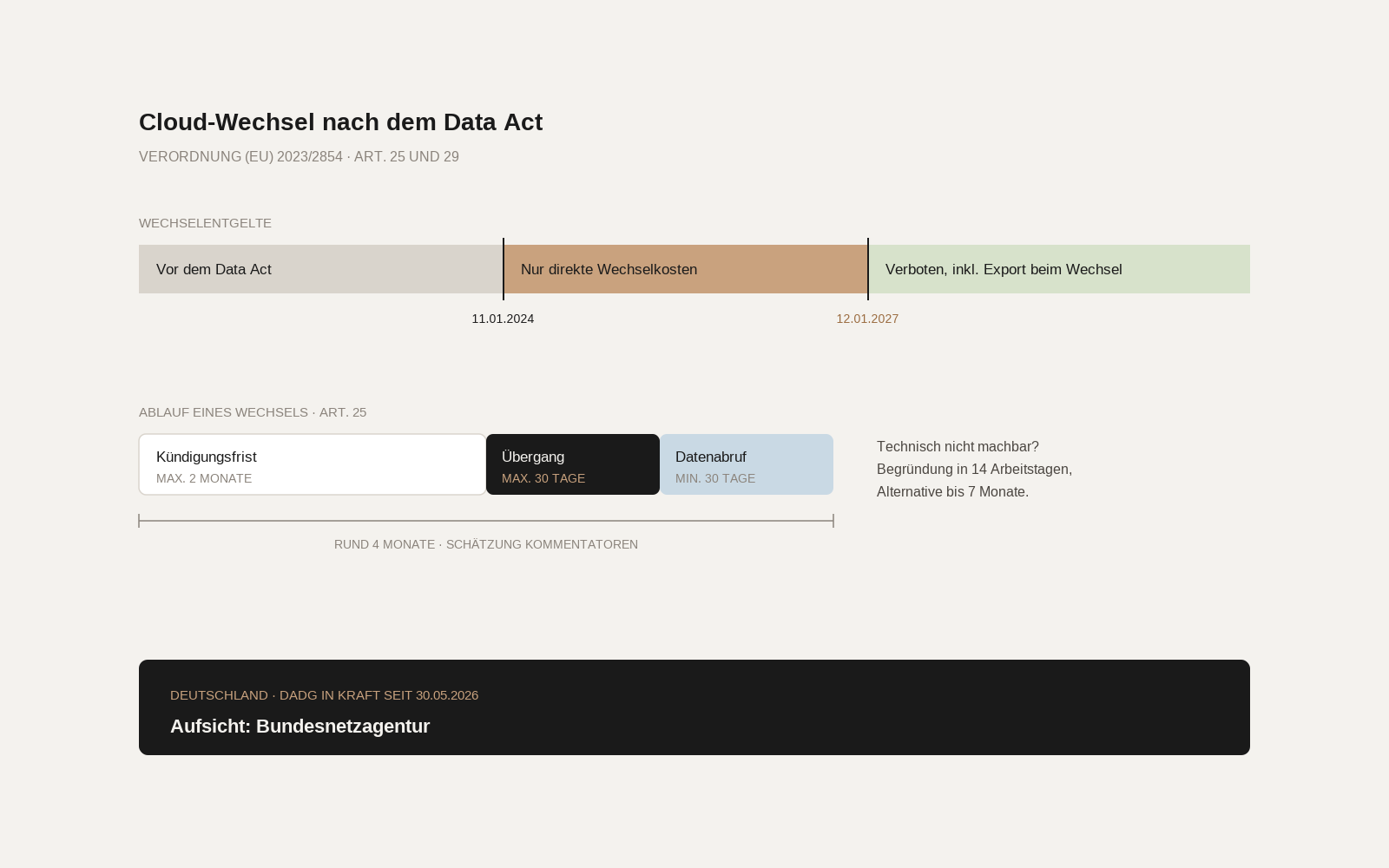
In seven weeks, the last charges for switching cloud providers in the EU disappear. From 12 January 2027, Article 29 of the Data Act (Regulation (EU) 2023/2854) bans switching charges for data processing services, including data egress charges for the switch. Until then, providers may only charge reduced fees capped at the costs directly linked to the switch. For data-centre operators, cloud providers and their customers, this is the last major Data Act deadline.
What does the Data Act cover?
The Data Act entered into force on 11 January 2024, and most obligations have applied since 12 September 2025. It governs access to and use of data from connected products. Chapter VI concerns switching between data processing services, meaning cloud, hosting and similar offerings. The switching obligations have applied since September 2025; only the complete removal of switching charges was deferred to 12 January 2027.
What becomes free from 12 January 2027?
Switching charges are then banned, including data egress charges incurred for the switch. According to commentary from several law firms and providers, ordinary service fees and early termination penalties are not covered. The Data Act defines switching charges explicitly as charges other than these. Ongoing egress fees in normal operation are therefore not banned outright, only those for switching.
Which timeframes apply to switching?
Article 25 sets out what a cloud contract must say about switching. The notice period for starting a switch may not exceed two months. It is followed by a transitional period of at most 30 calendar days, during which the provider supports the switch. If that is technically unfeasible, the provider must justify this within 14 working days and propose an alternative of no more than seven months. Under Article 25(5), the customer may extend the transitional period once if more time is needed. After that, the customer has at least 30 calendar days to retrieve their data. Commentators estimate that around four months pass from the request to the end of data retrieval. The 30 days count only from the end of the notice period, not from the request.
Does this apply to multi-cloud?
Only in part. If a customer uses several providers in parallel, Article 34(2) lets the provider pass on egress costs without exceeding those costs. A non-binding Commission FAQ reads this exception as continuing after 12 January 2027. Anyone permanently synchronising data between two providers should not expect free egress.
What has applied to connected products since September 2026?
Since 12 September 2026, the obligation in Article 3(1) has applied: connected products placed on the market after that date must be designed so that users can easily obtain their data. Products already on the market before then do not have to be retrofitted. For operators buying new sensors, machines or meters, this is a point for the next tender.
Who supervises this in Germany?
The Bundestag passed the act implementing the Data Act (DADG) on 26 March 2026. It was published in the Federal Law Gazette on 29 May and has applied since 30 May 2026. Under section 2 DADG, the Federal Network Agency (Bundesnetzagentur) is the competent authority. The Federal Data Protection Commissioner covers data protection for non-public bodies. The Federal Network Agency has investigation and enforcement powers and a catalogue of fines. According to commentators, how strictly Article 29 will be enforced in practice is still open.
In practice
Three steps help before 12 January. First, review existing cloud and hosting contracts for switching and egress charges and clarify which of them fall away in January. Second, for multi-cloud set-ups, have ongoing egress costs listed separately, since they are not covered by the ban. Third, for new connected products, specify in the tender how users obtain their data. The same applies to geodata: receiving results in open formats such as GeoTIFF, Shapefile or CSV keeps you flexible when switching. SOLAIN delivers its analyses in such formats.
Sources
- Wikipedia: Data Act (European Union)
- eudataact.net: Data Act timeline 2024 to 2028
- WZ-IT: What becomes free on 12 January 2027 and what does not
- Nordia Law: Cloud switching under the Data Act
- Atomity: Switching charges end on 12 January 2027
- Pilae: Data Act switching charges end in January 2027
- Lexology: Chapter VI of the Data Act and cloud switching
- eudataact.net: cloud switching, process and deadlines
- Global Law Experts: access-by-design duty from September 2026
- German Bundestag: Bundestag adopts EU rules on data access, 26 March 2026
- BMDS: act implementing the Data Act
- Gesetze im Internet: DADG
- Härting: Data Act implementing act, what companies need to know
- Cybervize: Data Act, DADG and the Federal Network Agency's role