EU Space Act Before the Committee Vote: Which Satellite Data May Still Be Sold in the EU
On 29 October the Irish Council Presidency circulated a new compromise text of the EU Space Act, and Parliament's industry committee is due to vote on 10 November. At its core is a provenance rule for satellite data that affects anyone who buys reports from orbit.
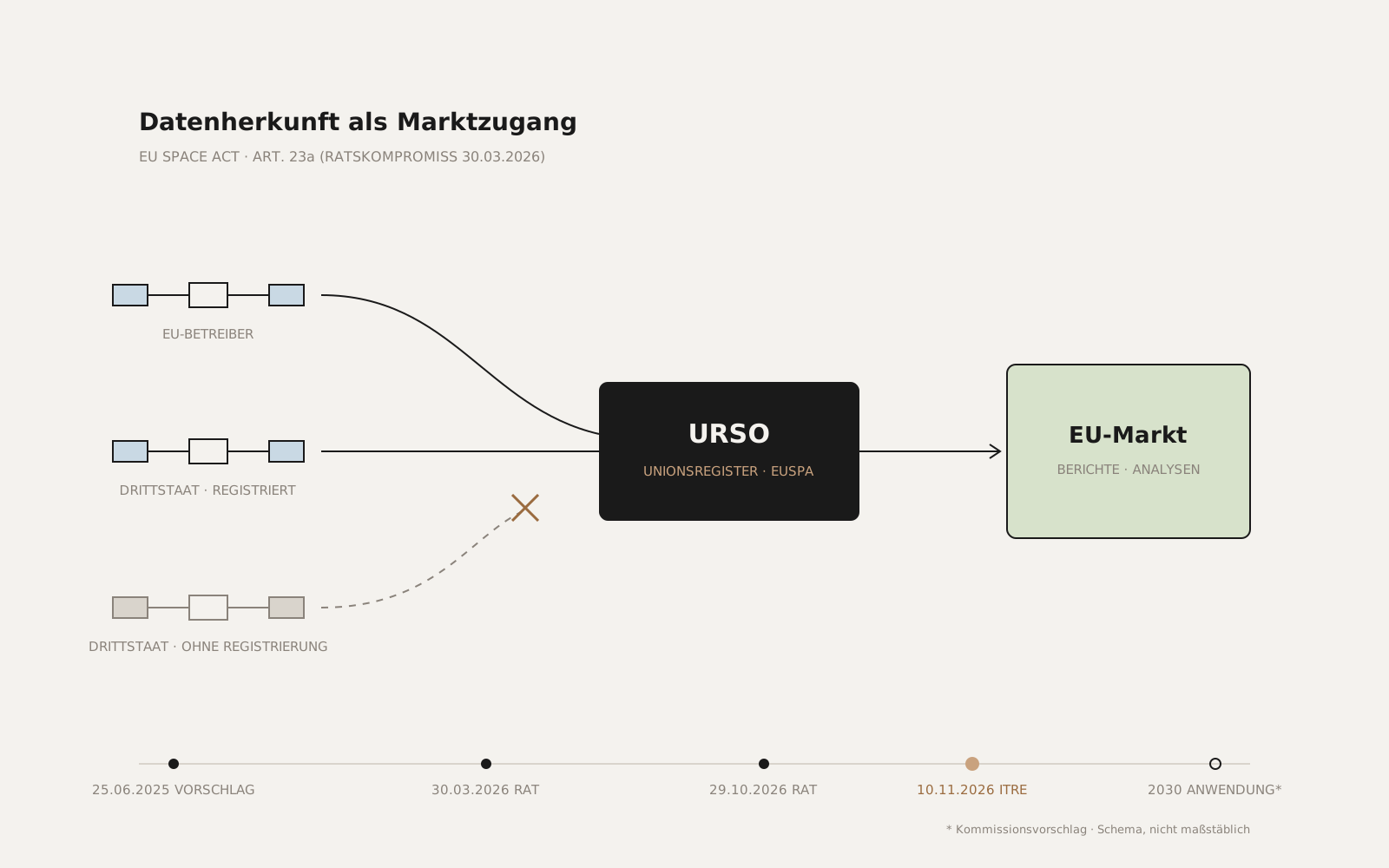
The EU Space Act is entering its decisive phase. On 29 October 2026 the Irish Council Presidency circulated an updated draft, and the European Parliament's industry committee (ITRE) is due to hold its first formal vote on 10 November 2026. For buyers of satellite analytics, one rule matters most: data from space would only be allowed on the EU market if the satellite that produced it is entered in an EU register.
Update 16 November 2026: The industry committee did not vote on 10 November. After a preliminary cross-party deal on 4 November, the vote is scheduled for 19 November 2026, according to EU Agenda.
What is the EU Space Act?
The European Commission tabled the proposal on 25 June 2025 (COM(2025) 335). It sets one framework for the safety, resilience and sustainability of space activities instead of separate national laws. The Commission proposed applying it from 1 January 2030. The Council instead favours 36 months after entry into force, with transition periods for certain categories.
What changes for satellite data?
Under the Commission draft, primary data providers may supply data in the Union only if the space objects generating it are registered in the Union Register of Space Objects (URSO). The register is run by the EU Agency for the Space Programme, EUSPA. Exceptions are foreseen for research and education.
The Cyprus Presidency compromise of 30 March 2026 tightened this logic. A new Article 23a makes data provenance a condition of market access. It applies to third-country operators and to data providers that supply data in the Union. Anyone operating satellites outside the EU and producing data for the EU market would first need to register.
How do non-EU operators get registered?
Either the Commission finds the home country's rules equivalent, or EUSPA assesses the operator case by case. Without an equivalence decision, third-country operators must also appoint a legal representative in the EU.
Who is warning about side effects?
The EEA EFTA States have pointed out that restrictions on third-country data could hit emergency and civil-protection services that rely on it. The industry association CCIA estimates, as cited by Via Satellite, that the Act would raise manufacturing and design costs for LEO satellites by 10 to 46 percent. That is an industry estimate, not an official figure.
Which dates are known so far?
- 25 June 2025: The Commission tables the proposal.
- 3 March 2026: Parliament's rapporteur publishes her draft report. It focuses on simplification, including cutting the maximum authorisation timeline from twelve to six months.
- 30 March 2026: The Cyprus Presidency presents its compromise text with the provenance rule in Article 23a.
- 29 October 2026: The Irish Presidency circulates a new compromise text. Among other things, it ties the certification of a launch to the member state from whose territory it takes place.
- 10 November 2026: Planned first vote in the ITRE industry committee.
- 1 January 2030: Proposed date of application according to the Commission. For certain categories the proposal names 1 January 2032.
What happens next?
All member states still hold scrutiny reservations. Scope, governance and the treatment of third-country operators are among the open points. Parliament's rapporteur is Elena Donazzan (ECR, Italy), whose draft report has been available since 3 March 2026. After the committee vote, negotiations between Parliament, Council and Commission follow. There is no agreement yet.
In practice
Anyone buying analytics built on satellite data should know where the data comes from. Three questions help at the next tender or contract renewal: Which satellites and operators supply the raw data? Are those operators based in the EU, or do they plan to register? Is there a European or open-data alternative if one data stream disappears? Long contracts tied to a single non-EU source carry a risk from 2030 that is still cheap to avoid today. The question matters for municipalities too. Heat planning and climate adaptation increasingly rely on satellite data, often through service providers who buy data from several operators themselves. Tender specifications can already require that data provenance is disclosed. Data-centre and site planners commissioning land or heat analyses should ask for the same transparency.
SOLAIN builds its analyses on open Copernicus data.
Sources
- European Commission: Proposal COM(2025) 335, EUR-Lex
- Council of the EU: Cyprus Presidency compromise text, ST 7806/26, 30 March 2026
- U.S. Department of Commerce: EU Space Act Update (November 2026)
- Vega Strategy: The EU draws its line at the launch pad
- The European Post: Parliament pushes back EU Space Act vote until November 2026
- E+H Rechtsanwälte: From Satellites to Data – Cyprus Presidency Compromise
- Heuking: "Reaching Wide" – EU Space Act from the perspective of third-country operators
- Via Satellite: The EU Space Act – Building a Market or Adding a Burden? (opinion)
- EEA EFTA Standing Committee: Comment on the EU Space Act Proposal
- Space Law Journal: The EU Space Act – What One European Rulebook Would Change
- Frontiers in Political Science: EU Space Act analysis (2026)
- European Parliament Legislative Train: EU Space Law