Eight Weeks to the EUDR: Record Low in Amazon Deforestation and What Buyers Now Have to Prove
On 30 December 2026, the EU Deforestation Regulation applies to large and medium-sized companies. Brazil reports the lowest deforestation since 1988, and Germany's implementing act is in committee. What this means for supply chains in soy, beef, timber, coffee and cocoa.
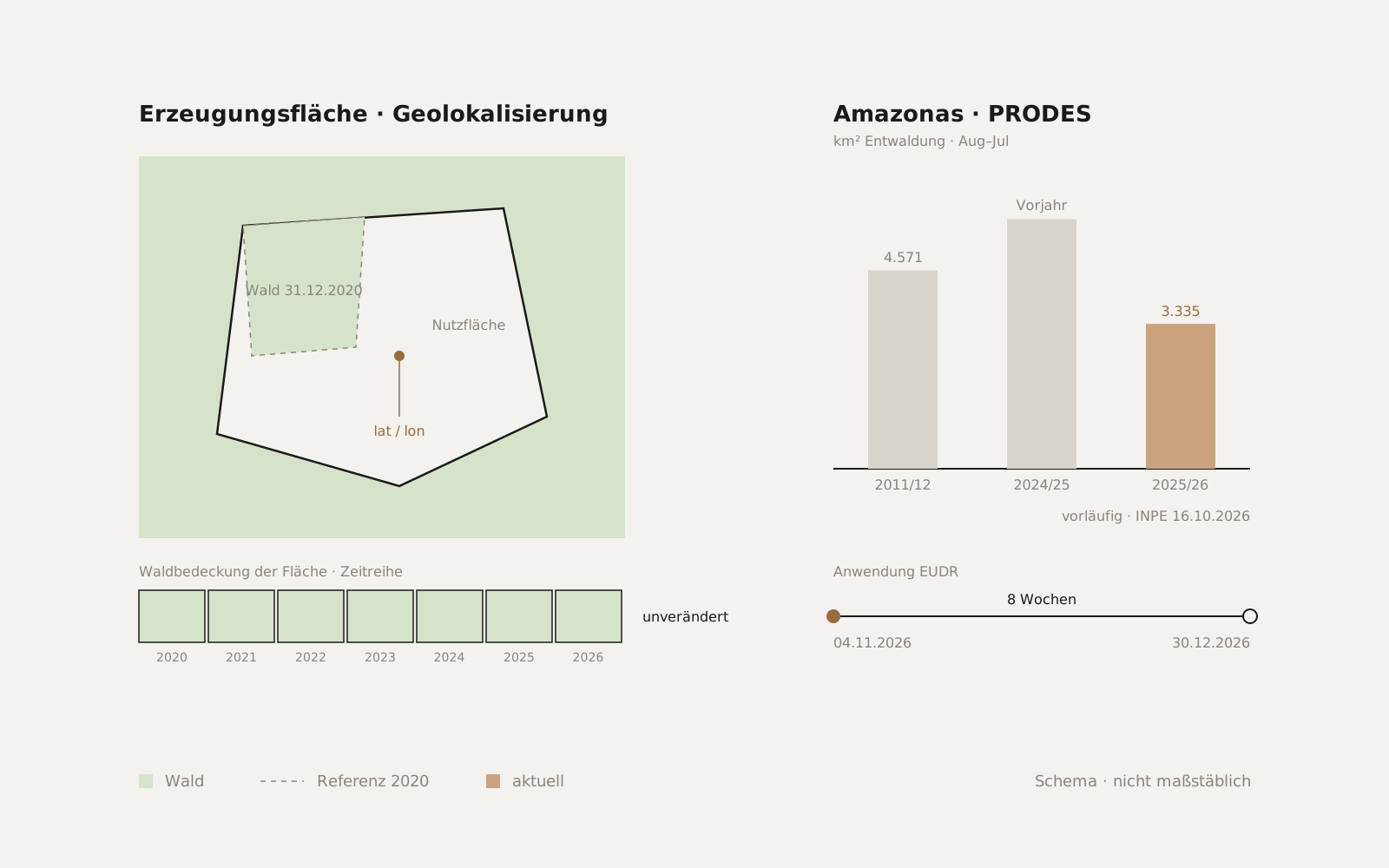
The date is set
With Regulation (EU) 2025/2650, the EU postponed the application of the Deforestation Regulation (EUDR) once more: it applies from 30 December 2026 to large and medium-sized operators and traders, and from 30 June 2027 to micro and small enterprises. Since then, the Commission has confirmed the timetable several times. In its report of 4 May 2026 (COM(2026) 191) it announced a simplification package but stated explicitly that it would not reopen the text of the regulation and would not postpone the application date. On 13 July 2026 it followed up with an update of the product scope and an implementing act setting the technical rules for the Information System. As of late October, no proposal to change the dates is on the table.
The Information System itself has been open again since the end of June 2026 for registrations, due diligence statements and simplified declarations, with a separate test environment. The Commission announced additional training dates in July and September, including dedicated sessions for micro and small producers. In Germany, the Bundestag held the first reading of the EUDR implementing act (printed paper 21/8278) on 8 October 2026; it is now in the agriculture committee and is also scheduled to enter into force on 30 December 2026.
What has been simplified and what has not
The revision has shifted obligations along the supply chain. A due diligence statement now has to be filed only by whoever first places a product on the EU market; downstream traders instead file a one-time simplified declaration. For German producers, existing land-parcel information is recognised as a due diligence system, because Germany is classified as a low-risk country.
What has not changed is the core: every due diligence statement requires the geolocation of the production plots and a finding that the risk of deforestation after 31 December 2020 is zero or negligible. For soy, beef, palm oil, timber, coffee, cocoa and rubber from standard-risk countries, that is not a formality but a check of individual plots against forest-cover data.
Brazil reports a record low
On 16 October 2026, Brazil's space institute INPE published the preliminary PRODES figure for the twelve months to July 2026: 3,335 square kilometres of deforestation in the Amazon, around 42 percent less than the year before and the lowest value since the series began in 1988. The previous low was 4,571 square kilometres in 2011/12. By state, 1,130 square kilometres fell in Pará, 849 in Mato Grosso and 525 in Amazonas. In the Cerrado, the savanna region where a large share of Brazilian soy is grown, clearing fell 24 percent to 5,516 square kilometres, also a record low.
The figure is preliminary: it is based on 271 of 516 priority satellite scenes, and the final rate will follow in the first half of 2027. And it is an area balance for the whole Amazon, not a statement about individual suppliers. For buyers it is nonetheless important news: the trend shows that the situation in the regions of origin is improving, and the data basis on which INPE calculates these figures is the same one that can be used to check individual plots.
What checking individual plots requires
At its core, the EUDR demands an answer to a simple question for every production plot: was there forest on 31 December 2020, and is it still there today? The answer comes from satellite data. Public series such as Landsat and Sentinel-2 have documented forest cover for decades at resolutions of 10 to 30 metres; for small parcels of coffee or cocoa farmers that is often not enough, and higher-resolution commercial imagery is then needed.
For large supply chains, it is less about the individual parcel than about the system: thousands of geolocations have to be checked against a time series, anomalies flagged and documented, and this repeatably, because the competent authorities check statements on a sample basis. A procedure that delivers a traceable forest-cover time series from 2020 onwards for every plot is therefore not an add-on but the core of the due diligence obligation.
In practice
For a procurement team that has to file due diligence statements for the first time in eight weeks, this means the list of production plots with coordinates is the starting point, and every plot without a clean time series is an open question. Satellite-based analysis can provide these time series for all plots in a supply chain and update them annually, so that checking becomes an ongoing process rather than a one-off exercise before the deadline. The fact that Amazon deforestation is currently at its lowest level since 1988 does not make the check unnecessary; it makes it easier to pass.
Sources
- European Commission: Report to the Council and Parliament on the EUDR, COM(2026) 191 (4 May 2026)
- European Commission: Commission updates product scope and tools to support EUDR (13 Jul 2026)
- European Commission / Access2Markets: Delay until December 2026 and other developments in the implementation of the EUDR
- Council of the EU: Deforestation – Council signs off targeted revision to simplify and postpone the regulation (18 Dec 2025)
- EY: EU Deforestation Regulation application postponed to 30 December 2026
- CMS: EUDR Amendments – Postponed Deadlines and Simplified Due Diligence
- Polygon One: EUDR current status – delay, latest news and deadlines
- iCustoms: EUDR News 2026 – Latest Updates, Dates and Scope Changes
- Gafta: EU Deforestation Regulation update – Information System training
- Mongabay: Amazon deforestation falls 42% to a record low (October 2026)
- Al Jazeera: Brazil's Amazon deforestation hits lowest level on record (17 Oct 2026)
- Wood Central: Amazon Deforestation 2026 Falls to Lowest Since 1988