Record Exports, Announced Quota: Guinea's Bauxite and the Question of What Is Actually on the Quay
Guinea shipped more bauxite in the first half of 2026 than ever before. At the same time, an export cap has been announced but not enacted. For alumina refineries and shipowners, the situation is decided at a handful of loading points that can be observed from orbit.
A record half-year
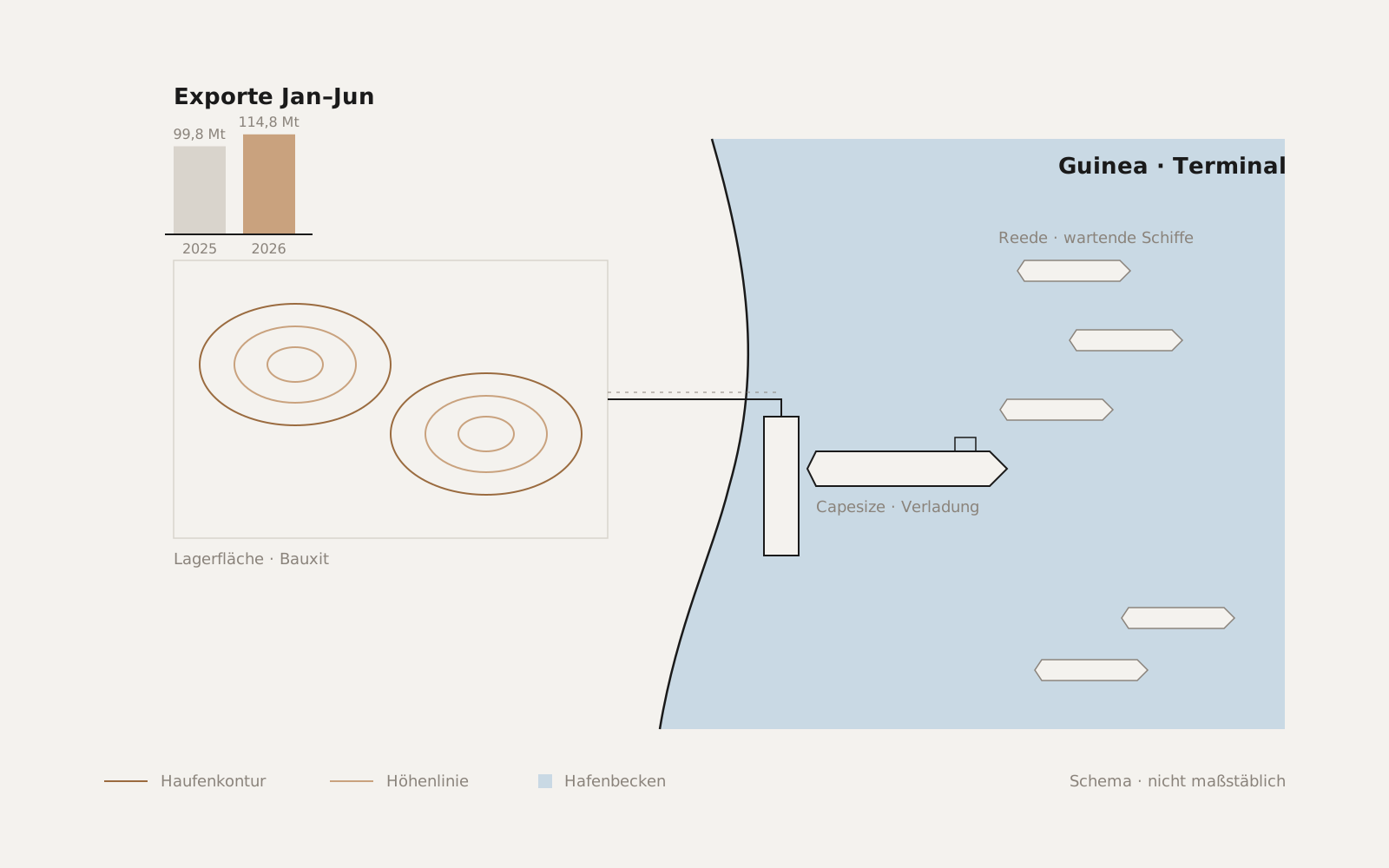
Guinea, the world's largest bauxite exporter, shipped 114.8 million tonnes of bauxite between January and June 2026 according to mines ministry data, 15 percent more than the 99.8 million tonnes in the same period a year earlier. The second quarter alone accounted for 53.9 million tonnes, up 5.3 percent year on year. For comparison, the country had already set a record of 182.8 million tonnes for the whole of 2025; market observers consider more than 180 million tonnes likely for 2026 and 200 million tonnes within reach if demand holds.
The driver is China. In 2025, 75.3 percent of China's 158 million tonnes of bauxite imports came from Guinea, which thereby feeds roughly half to two thirds of Chinese alumina capacity. Imports from Guinea peaked at 19.6 million tonnes in May 2026 and fell back to 15.89 million tonnes in June and 14.9 million tonnes in July. Analysts read the May spike as front-loading ahead of an expected export cap.
The quota that does not yet exist
Since the spring, the Guinean government has been announcing plans to regulate bauxite exports to support a price that has been falling since 2025. Mines Minister Bouna Sylla put it this way in May: exports were not being banned, but production and exports would be regulated and volumes reduced. Traders talk of a possible ceiling of 150 million tonnes per year. The decree required for this was first announced for April, then for June. As of late August it remains unsigned, and there is neither a confirmed total quota nor allocations to individual companies. Meanwhile, prices from Guinea (FOB) stand at around 38 to 39 US dollars per dry tonne.
This situation is uncomfortable for buyers: the record volumes show that the capacity is there, the announced quota shows that it could be cut politically, and the timing is open. Anyone relying on supply contracts with Guinea is currently planning against a moving target.
What it means for shipping
Bauxite from Guinea is carried to China mainly on Capesize vessels, and the long route around the Cape of Good Hope makes the country one of the most important demand drivers for that segment. Freight rates are correspondingly sensitive to loading activity off Kamsar, Boké and the newer terminals. For the fourth quarter, analysts expect bauxite flows to soften as front-loaded Chinese purchases fade and the quota question weighs on volumes.
The infrastructure has changed in a short time. Guinea has almost doubled its port capacity within a year, from five to nine operating terminals. That means more loading points, more anchorages with waiting ships, and a more complex picture than the ministry's monthly statistics convey.
Why on-the-ground observation matters
For alumina refineries, commodity traders and charterers, several questions converge in Guinea that statistics alone cannot answer. Will less actually be loaded once the decree arrives, or will the terminals keep running? How large are the stockpiles at the loading points, and are they growing because the mines produce faster than the ships can load? How many vessels are lying off the terminals and how long are they waiting?
These are precisely the questions that can be answered from orbit. The stockyards at the terminals are large, the red bauxite stands out clearly from its surroundings, and the piles can be estimated in area and height from optical time series. AIS data shows in parallel which ships berth when and how waiting times develop. Together they produce a picture that can be updated weekly and independently of official reporting.
In practice
For a procurement team, this is not about replacing the ministry figures but about checking them and seeing changes earlier. Anyone tracking stockpiles and vessel movements at the relevant terminals will detect an actual slowdown in loading weeks before the next export statistics, and can tell whether a decline in Chinese imports is down to Guinea or to the buyers. In a market where a single decree could shift volumes by a fifth, that is a difference that shows up in contract negotiations.
Sources
- MINING.COM / Reuters: Guinea first-half bauxite exports hit record high on Chinese demand
- Mining Weekly: Guinea first-half bauxite exports hit record high on Chinese demand (23 Jul 2026)
- Mysteel: Guinea's H1 bauxite exports hit record 114.8Mt as China keeps demand resilient
- Mysteel: Guinea's red earth rolls on – Bauxite exports race toward 200 mln t in 2026
- Miningmx: Guinea unveils plan to curb bauxite exports after surge (25 May 2026)
- MINING.COM: Top bauxite producer Guinea to unveil export controls in June
- China Global South Project: China-Guinea Trade Is a Story of Bauxite and Iron
- Rio Times: Guinea Explained 2026 – Bauxite, Simandou and Politics
- Discovery Alert: Record Bauxite Shipments Are Masking a Tightening Market
- Splash247: Bauxite storm brewing for capesizes
- Breakwave Advisors: China drives increased bauxite flows, but Guinea's cutback could drag on growth
- IndexBox: Bauxite Flows to Weaken in Q4 2026 as Guinea Quota and China Front-Loading Fade