Critical Raw Materials: Merz Calls for an EU Stockpile, Brussels Picks 46 New Projects. What Buyers Should Check Now
German Chancellor Merz called for European stockpiles of critical raw materials on 5 November 2026, weeks after the Commission selected 46 new strategic projects. For buyers of battery, magnet and metal inputs, the origin of their raw materials is becoming a question they have to answer.
Europe should hold critical raw materials in stock. German Chancellor Friedrich Merz said so on 5 November 2026 at an economic conference in Berlin, with reserves held at European level. The call comes shortly after the European Commission selected 46 new strategic projects for extraction, processing and recycling on 9 October 2026. It is not yet an agreed EU stockpile, but the direction is clear.
What did Merz propose?
According to Reuters, Merz argued that Europe must reduce its dependence on countries that dominate extraction and processing. He named stockpiles as a concrete measure alongside diversification and recycling. The European Post reports that he had already floated an EU body to coordinate purchasing and stockpiling on 21 October at the Berlin Global Dialogues. There is no separate binding decision on it yet.
Which 46 projects did the Commission select?
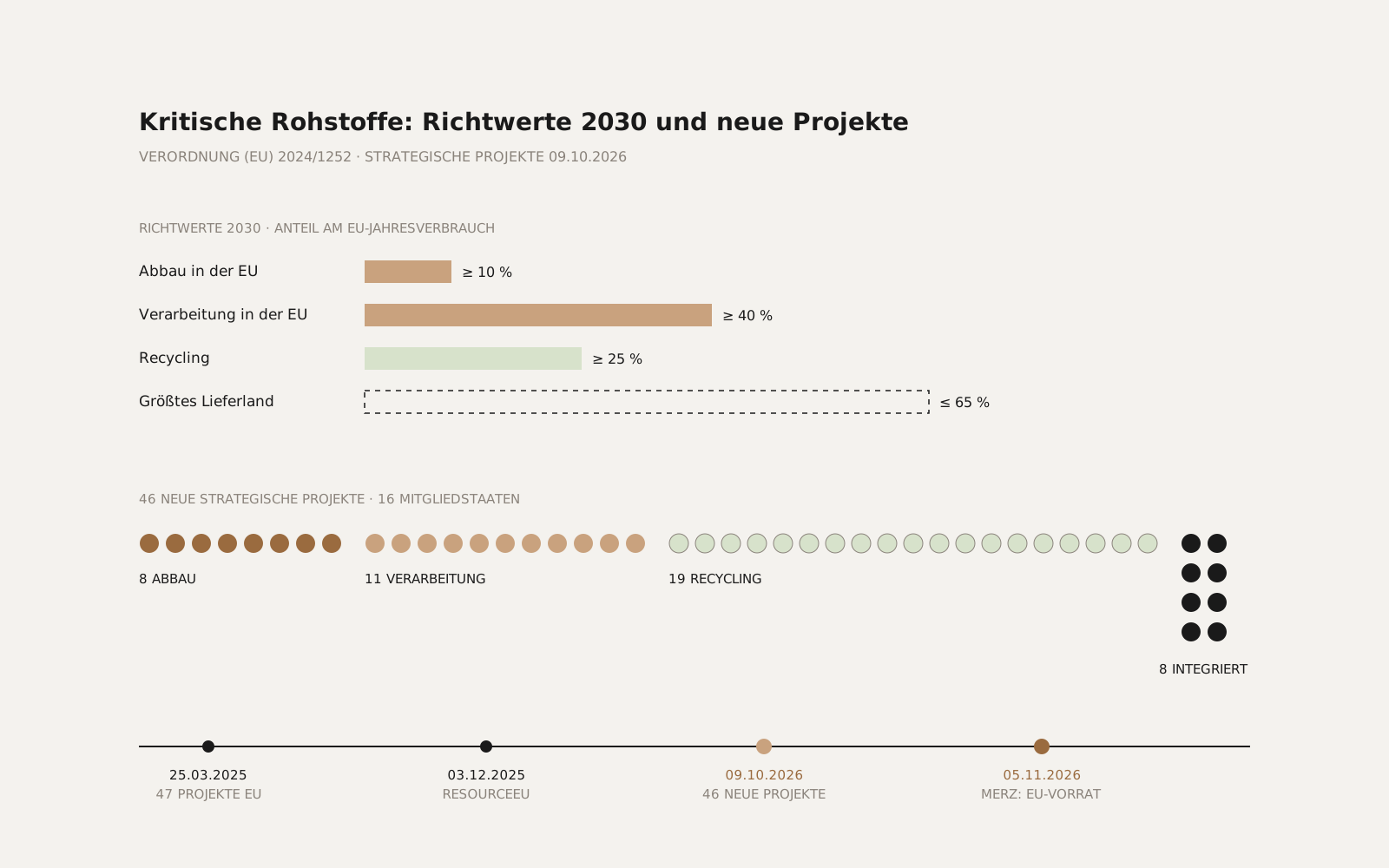
The new projects are in 16 member states and cover 15 of the 17 strategic raw materials. Eight concern extraction, eleven processing and 19 recycling, plus eight integrated projects. Battery materials dominate: seven projects for lithium, twelve for nickel, ten for cobalt, five for manganese and four for graphite. For defence and aerospace there are two magnesium and three tungsten projects, and for permanent magnets four rare-earth projects. Strategic projects get faster permits and help with financing. The Commission plans a new call towards the end of 2026. It had already selected 47 projects in the EU in March 2025, followed by 13 outside the EU in June 2025.
Which targets apply until 2030?
The Critical Raw Materials Act (Regulation (EU) 2024/1252) sets four benchmarks for strategic raw materials. At least 10 percent of annual EU consumption should come from extraction in the EU, 40 percent from processing in the EU and 25 percent from recycling. No single third country should supply more than 65 percent of demand. The extraction benchmark applies only as far as EU reserves allow.
How large is the dependence?
For some materials it is very high. According to Euronews, Commission President Ursula von der Leyen said in October 2025 that more than 90 percent of the rare-earth permanent magnets used in the EU come from China. For magnesium metal, a Euronews report puts China's share of EU supply at 97 percent, and at 31 percent for tungsten. In February 2026 the European Court of Auditors warned that the EU's climate goals are at risk without critical raw materials from China. This concentration is exactly what the 65 percent cap per supplier country is meant to reduce.
What do companies have to do themselves?
Large companies that manufacture strategic technologies must review their supply chains for strategic raw materials at least every three years. Large means an average of more than 500 employees and more than 150 million euros in worldwide net turnover. The review covers where the materials come from, factors that could disrupt supply, and the company's own vulnerabilities. On 3 December 2025 the Commission proposed tightening this duty: it would identify the companies itself, which would then have six months and would have to present the results to their board. That proposal has not been adopted yet.
How does a stockpile fit RESourceEU?
With the RESourceEU action plan of 3 December 2025, the Commission announced a European Critical Raw Materials Centre. It is meant to pool market intelligence and to steer and finance strategic projects. A stockpiling pilot and a joint purchasing mechanism that matches buyers and suppliers come with it. According to the IEA, the priorities are rare-earth permanent magnets, battery raw materials and defence-related materials. Merz's proposal would extend this approach into a permanent European reserve.
In practice
Buyers of battery, magnet and metal inputs can take three steps. First, record for each strategic raw material which country it comes from and how large the share of the biggest supplier country is. Second, check whether the company falls under the supply-chain review duty, and follow the Commission's proposal. Third, consider joint purchasing through the EU platform as an additional source. Tracking stockpiles at ports and handling sites shows shortages earlier than prices alone. SOLAIN monitors such stockpiles with open satellite data.
Sources
- Kitco (Reuters): Europe must stockpile critical raw materials, Germany's Merz says, 5 November 2026
- MINING.COM (Reuters): Europe must stockpile critical raw materials
- The European Post: Merz wants a critical raw materials stockpile run from Brussels
- European Commission: 46 new strategic projects (IP/26/2113)
- European Commission: Critical Raw Materials Act
- EU Transition Pathways: 47 strategic projects, March 2025
- Jones Day: The EU Critical Raw Materials Act and its impact on the mining sector
- CRMA explained: Regulation (EU) 2024/1252, Article 24 and amending proposal COM(2025) 946
- Gleiss Lutz: EU RESourceEU Action Plan
- IEA: RESourceEU Action Plan
- electrive: EU presents action plan for securing critical raw materials
- Euronews: EU seeks to end dependency on China for rare earths, October 2025
- Euronews: defence industry warns EU to curb dependence on key raw materials (magnesium, tungsten)
- Euronews: EU climate goals at risk without China's critical raw materials, EU auditors warn, February 2026