NRW Makes Climate-Adaptation Concepts Mandatory: What Municipalities Face from 2027
On 14 October 2026, the North Rhine-Westphalia state parliament passed the revised Climate Adaptation Act. From 2027, municipalities must draw up their own adaptation concepts. Other states are following. An overview of obligations, deadlines and the data question behind them.
The decision of 14 October
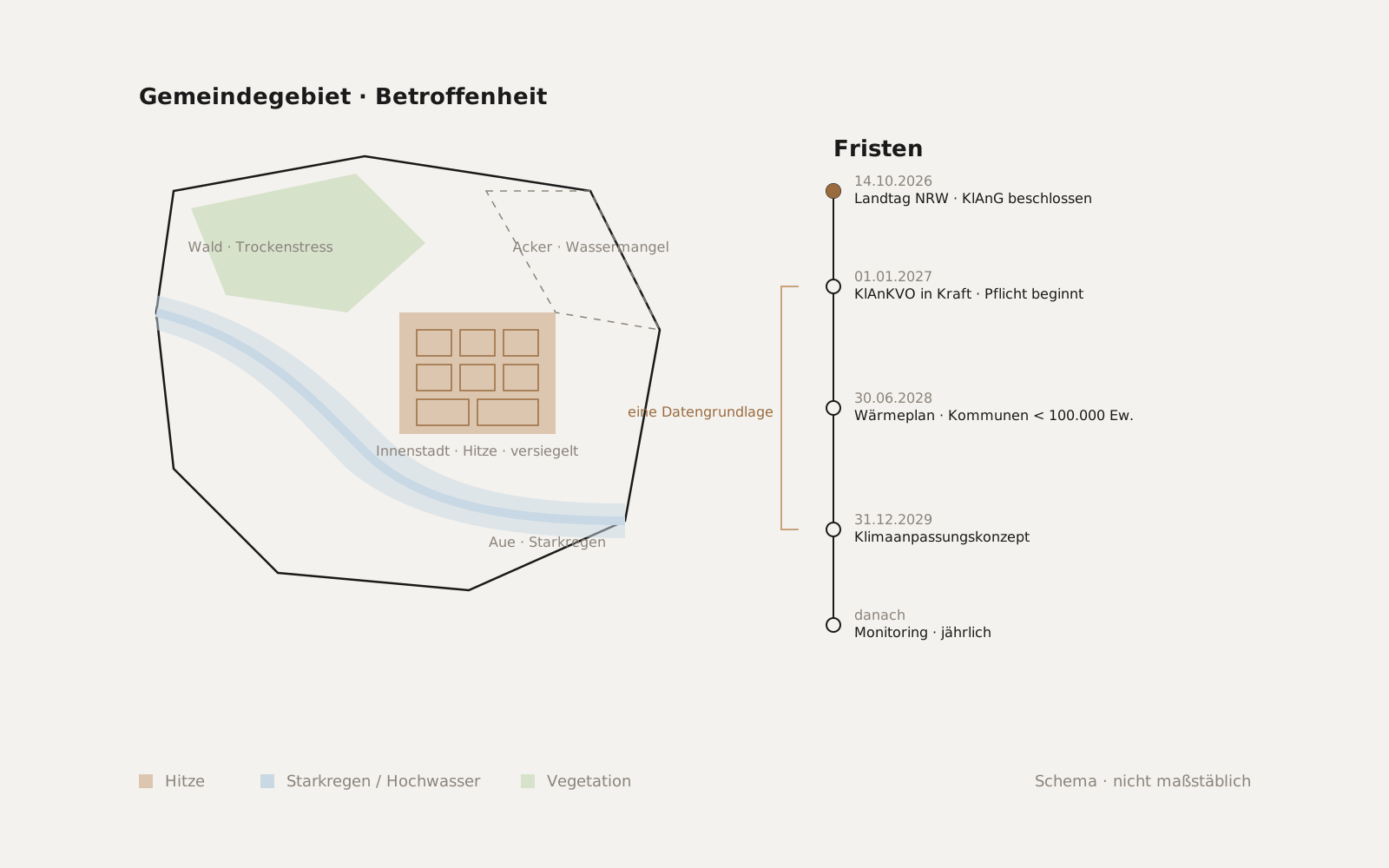
In its session on 14 October 2026, the North Rhine-Westphalia state parliament passed the revised Climate Adaptation Act NRW (KlAnG). Publication in the state gazette was still pending at the time of writing. At the heart of the revision is a new mandatory task: from 2027, municipalities in North Rhine-Westphalia are to draw up their own concepts for adapting to the consequences of climate change. Which cities and municipalities this applies to in detail is set out in the accompanying Climate Adaptation Concept Ordinance (KlAnKVO), which is to enter into force on 1 January 2027. The State Agency for Nature, Environment and Climate (LANUK) is to support municipalities in implementation.
According to reports on the draft bill in the spring, the state is providing around 20 million euros for the years 2027 to 2029, and the concepts are to be in place by the end of 2029. Trade media, citing the environment ministry, report a base amount of 55,000 euros per municipality plus a share based on population. In terms of content, the focus is on heavy rain, flooding, drought and water shortage; after summer 2026, heat is the topic that is unlikely to be missing from any concept.
The framework: a federal law without direct obligation
The federal Climate Adaptation Act (KAnG) has been in force since 1 July 2024. It obliges the federal government and the states to adopt adaptation strategies, but leaves it to the states whether and in what form municipalities must draw up their own adaptation concepts. The reason is constitutional: under Article 84(1) sentence 7 of the Basic Law, the federal government may not assign tasks directly to municipalities. The concrete obligations therefore only arise through state laws, and that is exactly what is now happening step by step.
North Rhine-Westphalia is not alone. In Saxony-Anhalt, the cabinet launched a draft implementing act for the KAnG in February 2026, under which districts and independent cities must draw up concepts for their territory; municipalities belonging to districts are deliberately relieved, and because it is a new mandatory task, financial compensation is provided for. The state parliament debated the draft in May. Saxony announced that it would present its climate-adaptation strategy in autumn 2026. Lower Saxony already regulates climate-adaptation concepts in section 26 of its climate act.
What an adaptation concept needs
A municipal climate-adaptation concept begins with an exposure analysis: where in the municipal area do heat, heavy rain, drought and flooding occur and with what intensity, and which people, buildings and infrastructure there are particularly vulnerable? Objectives, measures and monitoring build on that. For smaller municipalities without a specialist department, the first step is the hardest, because it requires area-wide data that so far has often been available only for large cities.
Much has changed here in recent years. For heat, thermal satellite imagery provides the surface temperature of every area of a municipality by day and by night and shows which neighbourhoods fail to cool. For heavy rain and infiltration, the degree of surface sealing is decisive, and it can be derived from optical satellite data for every parcel and every time slice. For drought, vegetation indices show where urban greenery and forests are under stress. All three datasets can be produced for a municipality of 8,000 inhabitants just as for a large city, and they can be updated annually, which is what makes the required monitoring possible in the first place.
Overlapping deadlines
For many municipalities in North Rhine-Westphalia, the new obligation falls in a phase in which heat planning under the Heat Planning Act is already under way: municipalities with fewer than 100,000 inhabitants must submit their heat plan by 30 June 2028, and the climate-adaptation concept by the end of 2029. Both procedures need a building and land-use analysis, both need monitoring, and both draw on the same foundations: building stock, surface sealing, vegetation, temperature.
There is a strong case for producing the data basis once and using it for both tasks. A neighbourhood that appears in the heat plan as a suitable area for a heat network is often the same dense, sealed neighbourhood that shows up in the adaptation concept as a heat island. Developing both plans from a common basis not only saves effort but also avoids contradictions between two documents adopted by the same council.
In practice
For a climate-protection manager or a building department in North Rhine-Westphalia, this means that before the ordinance enters into force on 1 January 2027, it is worth clarifying which data foundations already exist and which are missing, for heat, surface sealing and vegetation alike. Satellite-based analysis can cover the exposure analysis area-wide and for all municipality sizes, and supply the monitoring in subsequent years with comparable data. What remains is the municipal work: setting objectives, weighing measures, agreeing priorities with the council.
Sources
- Klimaatlas NRW: Wegweiser Klimafolgenanpassung NRW aktualisiert (state parliament decision of 14 Oct 2026)
- EUWID Wasser und Abwasser: NRW-Kommunen werden ab 2027 zur Erstellung von Klimaanpassungskonzepten verpflichtet (15 Oct 2026)
- Landtag NRW: Agenda E18-1831
- GRÜNE Landtagsfraktion NRW: Besser vorbereitet auf Hitze und Starkregen – NRW stärkt kommunale Klimafolgenanpassung (29 Apr 2026)
- Neue Westfälische: NRW verpflichtet alle Kommunen zu Klimaanpassungskonzepten
- Umweltministerium NRW: Klimaanpassung in NRW
- Verfassungsblog: Eine gesetzliche Pflicht zur Klimaanpassung – Das Bundes-Klimaanpassungsgesetz
- Klimastadtraum: Klimaanpassungsgesetz Kommunen – Pflichten und Förderung
- Magdeburg klickt: Kabinett bringt Landesgesetz zur Klimaanpassung auf den Weg (Saxony-Anhalt)
- Landtag Sachsen-Anhalt: Weekly overview 23/2026
- Sachsen Fernsehen: Sächsische Klimastrategie soll im Herbst vorliegen (30 Aug 2026)
- Lower Saxony: § 26 NKlimaG, Klimaanpassungskonzepte