Data Centre Waste Heat: What Stuttgart Shows and What the EnEfG Amendment Could Change
Since 24 September, a data centre in Stuttgart's Synergiepark has been heating a school and office buildings. On the same day, the Bundestag held the first reading of a bill loosening the waste-heat obligation. What municipalities and site planners should take from this.
A building network heated by servers
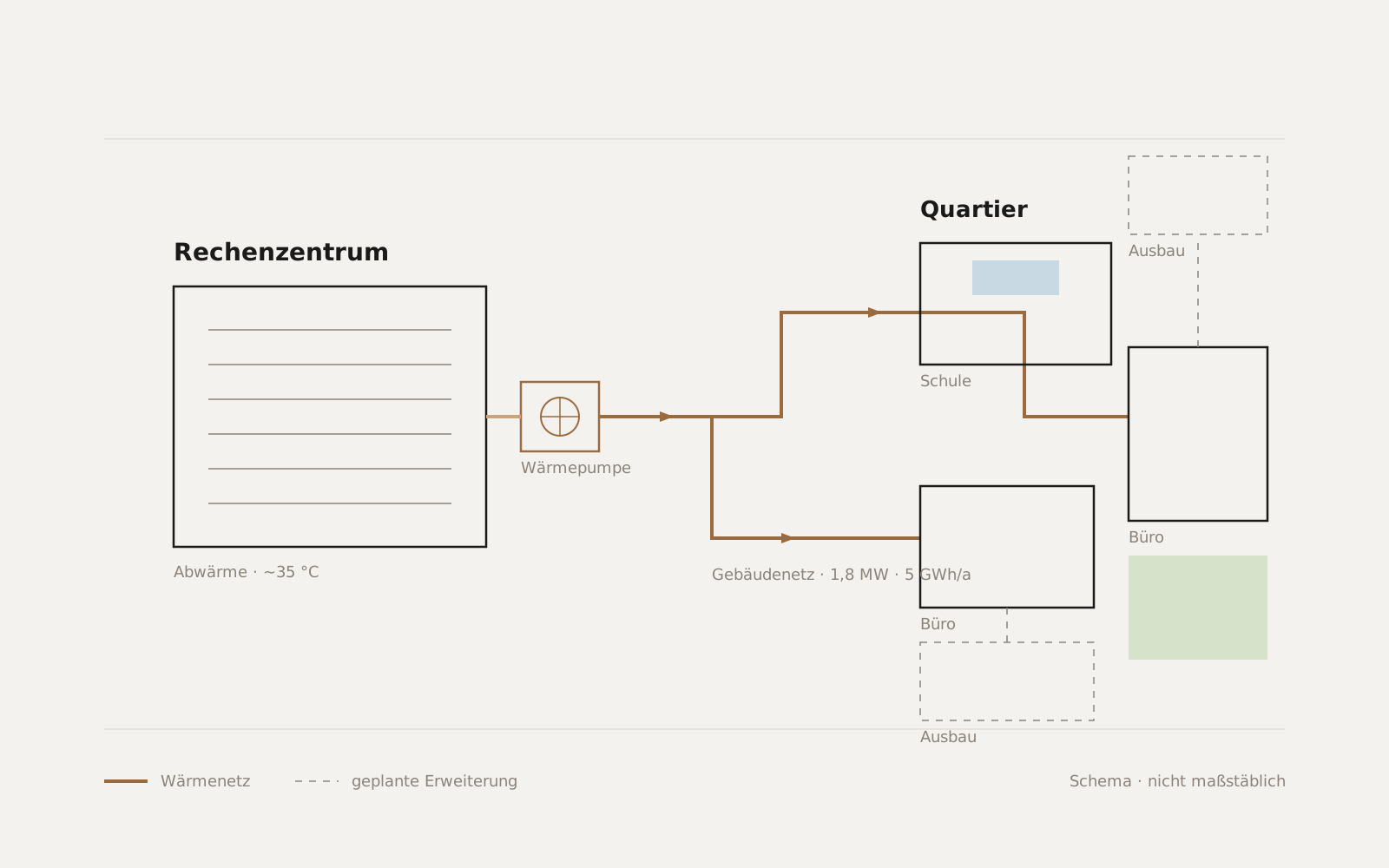
On 24 September 2026, a heat supply fed by a data centre went into operation in Stuttgart's Synergiepark business district. The building network is expected to deliver around five gigawatt-hours of heat per year and is designed for a capacity of up to 1.8 megawatts. The waste heat comes from a data centre operated by nLighten, is captured through a closed water loop and raised to the required temperature with heat pumps. The first customers include the city-run it.schule Stuttgart and several DEKRA buildings.
The network is being built by Wärmelösungen Synergiepark Stuttgart (WLSS), a joint venture of Stadtwerke Stuttgart and e-con AG. The network that has just started is seen as the first building block of a much larger scheme: the whole Synergiepark in the Vaihingen and Möhringen districts comprises around 350 buildings, and the two networks are to be connected later.
The project is not the first of its kind. In Frankfurt, the Telehouse data centre feeds waste heat at a constant 35 °C into a system in which Mainova lifts the temperature with large heat pumps. But Stuttgart is a good illustration of what such a scheme looks like in practice: a clearly defined source, a handful of large customers in the immediate vicinity, a municipally backed network operator, and an expansion path that follows the existing building stock.
Large potential, small uptake
A study by the German Technical and Scientific Association for Gas and Water (DVGW) puts the theoretical waste-heat potential of data centres currently operating in Germany at around 15 terawatt-hours per year. For comparison, the Stuttgart network delivers 0.005 terawatt-hours. The gap between what is technically available and what actually reaches a network is enormous.
The reasons are well known. Waste heat from air-cooled data centres comes at a low temperature and has to be lifted with heat pumps. Many sites sit in business parks with no existing network infrastructure. And legally there is no obligation to take the heat: the Energy Efficiency Act (EnEfG) obliges the operator to reuse waste heat, but neither the EnEfG nor the Heat Planning Act creates a duty for a network operator to accept it or to connect the data centre. Every feed-in remains a commercial agreement between two parties that first have to find each other.
The EnEfG amendment: cost-benefit analysis instead of obligation
On the same day Stuttgart went live, the Bundestag held the first reading of the government bill for the accelerated implementation of the EU Energy Efficiency Directive (printed paper 21/8027). According to the Bundestag's own summary, the minimum efficiency requirements for data centres are being loosened: the deadline for new data centres to meet efficiency targets rises from two to four years, and the obligation to source electricity entirely from renewables is pushed back from 2027 to 1 January 2030. The waste-heat requirement is to become more flexible: waste heat must be used only where a suitable heat network exists nearby.
According to analyses by law firms, the draft replaces the existing duty to use waste heat with a cost-benefit analysis, required only when a facility of one megawatt or more is planned or substantially modernised. For new data centres, a staggered waste-heat quota remains: 10 percent for facilities commissioned from July 2026, 15 percent from July 2027 and 20 percent from July 2028. Trade media criticise that a cost-benefit analysis opens a back door: anyone who can show that a connection to a heat network does not pay off is released from the obligation. The parliamentary procedure in the Bundestag and Bundesrat is not yet complete; observers expect adoption in November.
What this means for heat planning
For municipalities preparing or updating their heat plans under the Heat Planning Act, the core point does not depend on the outcome of the amendment: waste heat from data centres is a real, baseload-capable source, but only where source, customers and network fit together spatially. Stuttgart works because the school, the offices and the data centre sit in the same business park. A cost-benefit analysis of the kind the draft envisages will put exactly this spatial question at the centre.
That shifts part of the work onto the data side. Anyone who wants to designate suitable areas in a heat plan needs to know where existing and planned data centres are, which buildings within reach have high heat demand, and how land use in the business park is changing. Conversely, operators conducting a cost-benefit analysis have to show plausibly which customers at what distance come into question.
In practice
Satellite-based analysis can make a sober contribution here: thermal imagery shows which buildings and surfaces in a business park give off particularly large amounts of heat in winter, and optical time series document where the built environment is actually changing. Neither replaces network planning or a viability calculation. But together they provide an area-wide, repeatable basis for recognising sites like the Synergiepark in the first place, before moving into detailed planning.
Sources
- stadt+werk: Rechenzentrum versorgt Wärmenetz (24 Sep 2026)
- DEKRA: DEKRA setzt am Stuttgarter Hauptsitz auf Rechenzentrums-Abwärme
- Datacenter Insider: nLighten speist Abwärme in Wärmenetz im Synergiepark ein
- Bayern Innovativ: Abwärme aus Rechenzentrum versorgt Stuttgarter Synergiepark
- Mainova: Abwärme aus dem Rechenzentrum als Energiequelle
- INDUSTR: Rechenzentren-Abwärme verbindet Digitalisierung und Wärmewende (DVGW study)
- Energie und Recht: Abwärme aus Rechenzentren – Pflichten nach dem EnEfG
- Deutscher Bundestag: Beschleunigte Umsetzung der Energieeffizienzrichtlinie beraten (24 Sep 2026)
- CMS: EnEfG-Novelle bringt Entlastung für Rechenzentren
- Cleanthinking: EnEfG-Novelle – Sparziel und Abwärmepflicht sollen fallen
- ComputerBase: Energieeffizienzgesetz – Regierung will Energieregeln für Rechenzentren lockern