Data Centres Get an EU Label from A to G: What the New Rating Means for Operators and Municipalities
The European Commission plans to rate data centres above 500 kW of IT power from A to G on energy and water use, with the first labels expected in 2027. In parallel, a consultation on binding minimum standards runs until 14 December 2026.
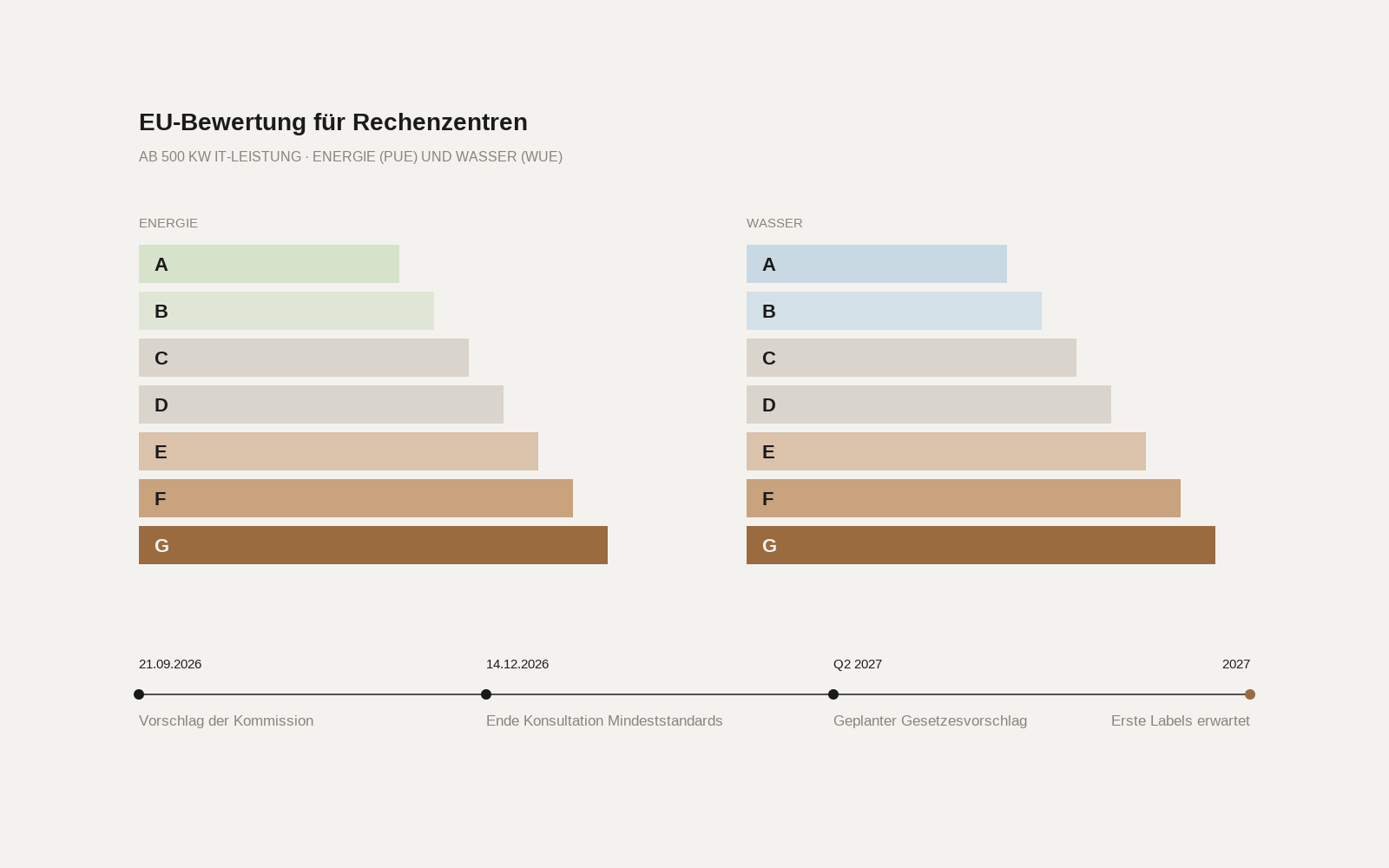
Data centres in the EU will soon carry a grade. On 21 September 2026 the European Commission proposed a common rating scheme. It covers individual data centres above 500 kW and makes their actual energy and water use visible. According to the Commission, the first labels are expected in 2027. Until 14 December 2026, operators, municipalities and associations can also have their say on whether binding minimum standards should follow.
What exactly is the Commission proposing?
The proposal is a delegated regulation under the Energy Efficiency Directive (EU) 2023/1791. It builds on Regulation (EU) 2024/1364, which has governed reporting since 2024. Data centres with at least 500 kW of installed IT power already report annual indicators to a European database, including energy and water use. What is new is that these data become a rating.
Each reporting data centre is to receive one grade from A to G for energy and one for water. The basis is the familiar metrics PUE (Power Usage Effectiveness) and WUE (Water Usage Effectiveness). According to the law firm Latham & Watkins, the label is generated automatically from the data operators already report to the database. The Commission says it will also show the contribution to the energy system, such as waste heat reuse and added renewable generation.
When does it apply?
After the proposal, Parliament and Council have two months for scrutiny. If neither objects, the regulation is published in the Official Journal and enters into force 20 days later. We have not yet found a publication. The Commission expects the first labels for individual data centres in 2027, and a first review of the scheme is foreseen by the end of 2028.
What is the consultation on minimum standards?
The rating itself sets no limits. A poor label does not prohibit anything. In parallel, however, the Commission has launched a consultation on minimum standards for new and refurbished data centres. It covers energy efficiency, water use, waste heat reuse and grid services. The consultation runs until 14 December 2026. A legislative proposal is planned for the second quarter of 2027. The Commission has not yet put forward concrete thresholds or metrics. That is why practical input matters now: which metrics can be measured, which limits are realistic at which sites, and what implementation costs. Responses are submitted through the Commission's consultation portal.
How does this fit Germany's Energy Efficiency Act?
In Germany, facilities from 300 kW of non-redundant rated connected load currently count as data centres under the Energy Efficiency Act (EnEfG). The government's draft amendment (Drucksache 21/8027) would raise this threshold to 500 kW of installed IT power. The German threshold would then match the EU rating. The draft also relaxes PUE requirements and the waste heat obligation. The amendment has not yet been adopted; it is still before the Bundestag.
What changes for whom?
For operators, the annual report becomes a public calling card. Anyone who reports inaccurately or incompletely today will later receive a label that customers, banks and authorities can see. For buyers of colocation and cloud services, the grade becomes a comparison criterion that can be requested in tenders. For municipalities, the scheme creates transparency about where larger data centres are located and whether they supply waste heat. That is an important input for municipal heat planning.
What should operators do now?
Three steps can be taken right away without any new obligation. First, check the last report to the European database: are metering points, periods and water use correct? These are exactly the values the grade will later be based on. Second, take part in the consultation by 14 December 2026 if minimum standards would affect the business model, for example at sites with no heat network nearby. Third, talk to the municipality. Many cities are drawing up their heat plans right now, and a data centre with available waste heat is a concrete building block for them. Operators that supply waste heat can later show this on the label too.
In practice
A label is based on self-reporting and appears once a year. Anyone comparing sites or planning waste heat use often needs an independent and more current picture. Satellite data show construction activity, sealed surfaces and heat signatures at site level. Combined with the data from the EU database, this makes heat plans and siting decisions easier to justify.
Sources
- European Commission: Making data centres energy efficient thanks to a new EU rating system (21 Sep 2026)
- European Commission: Press release IP/26/1667
- ManagEnergy: EU takes steps to rate and set minimum standards for data centres
- EUR-Lex: Delegated Regulation (EU) 2024/1364
- Latham & Watkins: European Commission Proposes Mandatory Sustainability Label for Data Centres
- Noerr: EU introduces common rating scheme and sustainability labels for data centres
- Arthur Cox: New Regulation on rating scheme and consultation on minimum performance standards
- Beveridge & Diamond: Commission advances data center sustainability ratings and consults on minimum performance standards
- German Bundestag: Drucksache 21/8027, government bill
- Energie und Recht: EnEfG for data centres, obligations and 2026 amendment