Grid Connection for Data Centres: What the Maturity Procedure and the Grid Package Change for New Sites
Since April 2026 the transmission system operators have allocated connections by project maturity rather than by date of request, and the federal grid package is meant to write this end of first-come-first-served into law. For data centres, what will count is how far a site is planned and whether it uses the capacity it requests.
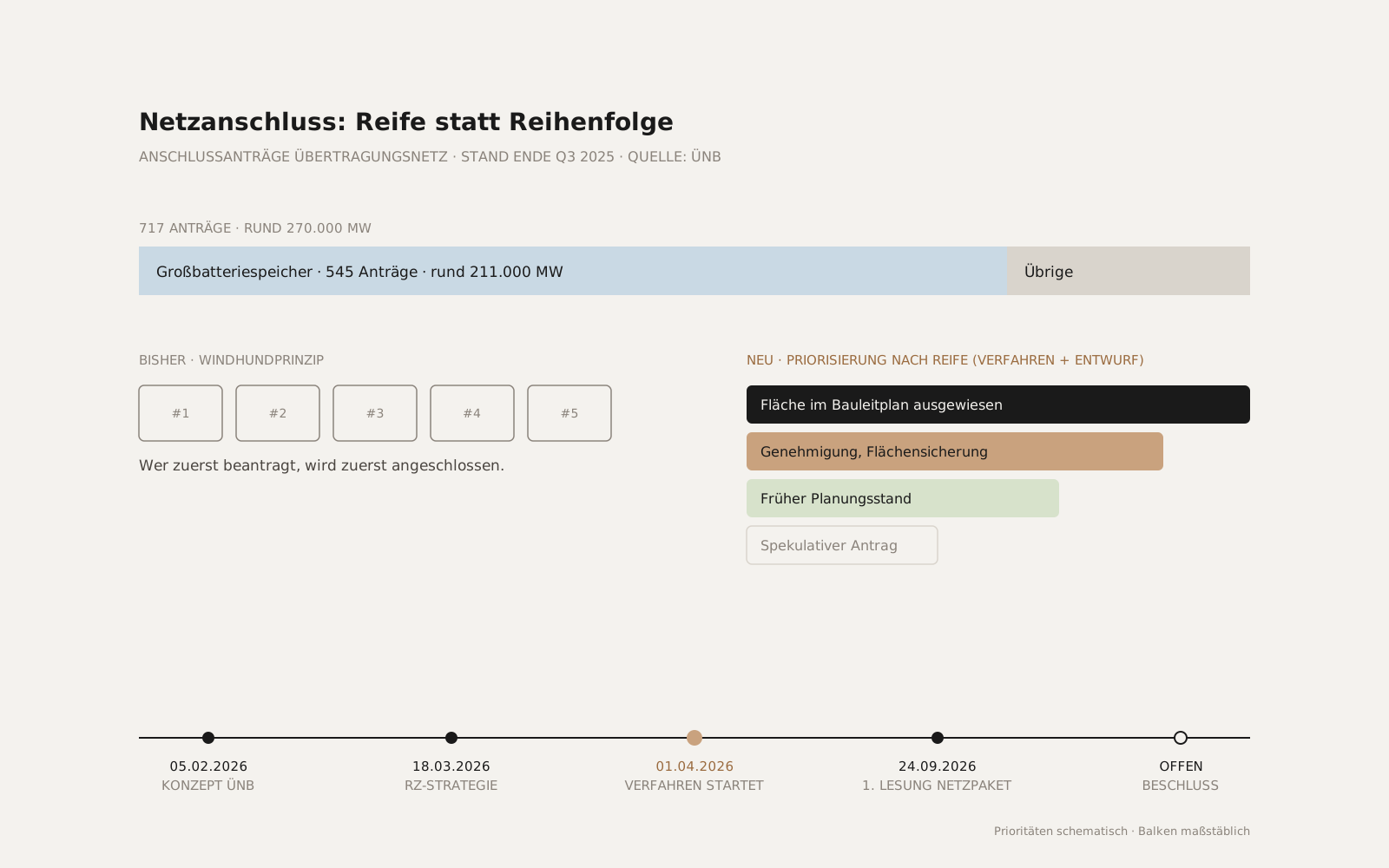
Connecting a data centre to Germany's transmission grid no longer means simply joining a queue. Since 1 April 2026, the four transmission system operators (TSOs) have applied a maturity procedure: connections go first to projects that can show they are well advanced. The federal grid package is meant to write this end of first-come-first-served into law. It has been before the Bundestag since September and has not yet been passed.
Why is a new procedure needed?
The queue is full, mostly with battery storage. According to the TSOs' concept, 717 connection requests totalling around 270,000 megawatts were pending at the end of the third quarter of 2025. Of these, 545 requests with around 211,000 megawatts came from large battery storage projects. Industry and data centres wait in the same line. Under the old rule, whoever applied first was served first, whether or not the project would ever be built.
How great is the pressure?
Demand from the industry is high. According to Clean Energy Wire, citing Tagesspiegel Background, the distribution grid operator in Brandenburg alone has received around 170 requests from data centres totalling 22 gigawatts since 2022. The Federal Network Agency expects data centres to use up to ten percent of Germany's electricity by 2037, up from around four percent today. Because connections take long, some operators are planning their own generation. The report cites CyrusOne's Frankfurt site, which plans a 61-megawatt gas-fired plant with E.ON alongside its grid connection.
How does the maturity procedure work?
The TSOs presented the procedure on 5 February 2026 and published 55 pages of documentation. It started on 1 April 2026 with a first information and application phase. It applies to connections of battery storage and large consumers to the transmission grid, which includes large data centres. Actual project progress counts, not the date of the request, which is meant to push back speculative requests that only reserve capacity.
What is in the grid package?
The draft law reorganises how grid connections are allocated. Grid operators would be able to prioritise requests according to statutory criteria. These include the security of the power system, statutory expansion targets and sites designated in regional and land-use plans, explicitly including sites for data centres. The Bundestag held the first reading on 24 September 2026. A public hearing in the Committee on Economic Affairs and Energy followed on 7 October 2026, where the package drew strong criticism. The second and third readings and the Bundesrat are still to come. Until publication in the Federal Law Gazette, the package's new rules do not apply; the operators' maturity procedure, by contrast, is already running.
What does the data-centre industry criticise?
The German Datacenter Association supports the reform in principle. It objects, however, to a rule allowing grid operators to cut connection capacity unilaterally if it has not been fully used for three years. Data centres grow in phases, and full load after three years is not the norm. Bitkom also welcomes the end of first-come-first-served according to its statement, but wants capacity withdrawn only if it stays unused permanently and after an individual review. The district heating association AGFW calls for data centres to be prioritised as strategic infrastructure.
How does this fit the Data Centre Strategy?
The federal cabinet adopted the National Data Centre Strategy on 18 March 2026. It aims to at least double Germany's data-centre capacity by 2030 and at least quadruple capacity for AI and high-performance computing. The strategy bundles 28 measures. According to the digital ministry's half-year review, 25 have started and four are complete. They include an industry standard for flexible connection agreements, which could connect sites before the grid is fully expanded.
In practice
For operators and developers, the question shifts from "When did we apply?" to "How far along is the project?". Three points help. First, favour sites that are explicitly designated in land-use or regional plans. Second, document project progress carefully, from securing the land to permits. Third, tie the requested capacity to a realistic build-out path in case the three-year rule comes. Municipalities that want to attract data centres can influence priority themselves through site designation in land-use planning. SOLAIN analyses data-centre sites and their surroundings from satellite data, such as construction progress and waste-heat potential.
Sources
- German Bundestag: first reading on energy law, 24 September 2026
- German Bundestag: hearing on the grid connection package, 7 October 2026
- Bundestag printed paper 21/8299
- TSOs: maturity procedure documentation (netztransparenz.de)
- 50Hertz: TSO press release, 5 February 2026
- pv magazine: TSOs introduce maturity procedure
- Clean Energy Wire: Germany to secure grid connections for data centres and industry
- Clean Energy Wire: data centres planning own fossil fuel plants
- GÖRG: Federal government adopts grid package
- German Datacenter Association: position on the grid connection package
- Bundestagszusammenfasser: statements on the grid package (incl. Bitkom, AGFW)
- BMDS: National Data Centre Strategy
- BMDS: half-year review of the Data Centre Strategy
- Gleiss Lutz: Federal Government adopts first national Data Centre Strategy