Small-Scale Heat Planning: What the WPG Amendment Is Meant to Change for Municipalities up to 15,000 Inhabitants
The amendment to Germany's Heat Planning Act would give small municipalities a much simpler procedure and add cooling planning for larger ones. The draft has been before the Bundestag since June, and experts see a clear need for changes.
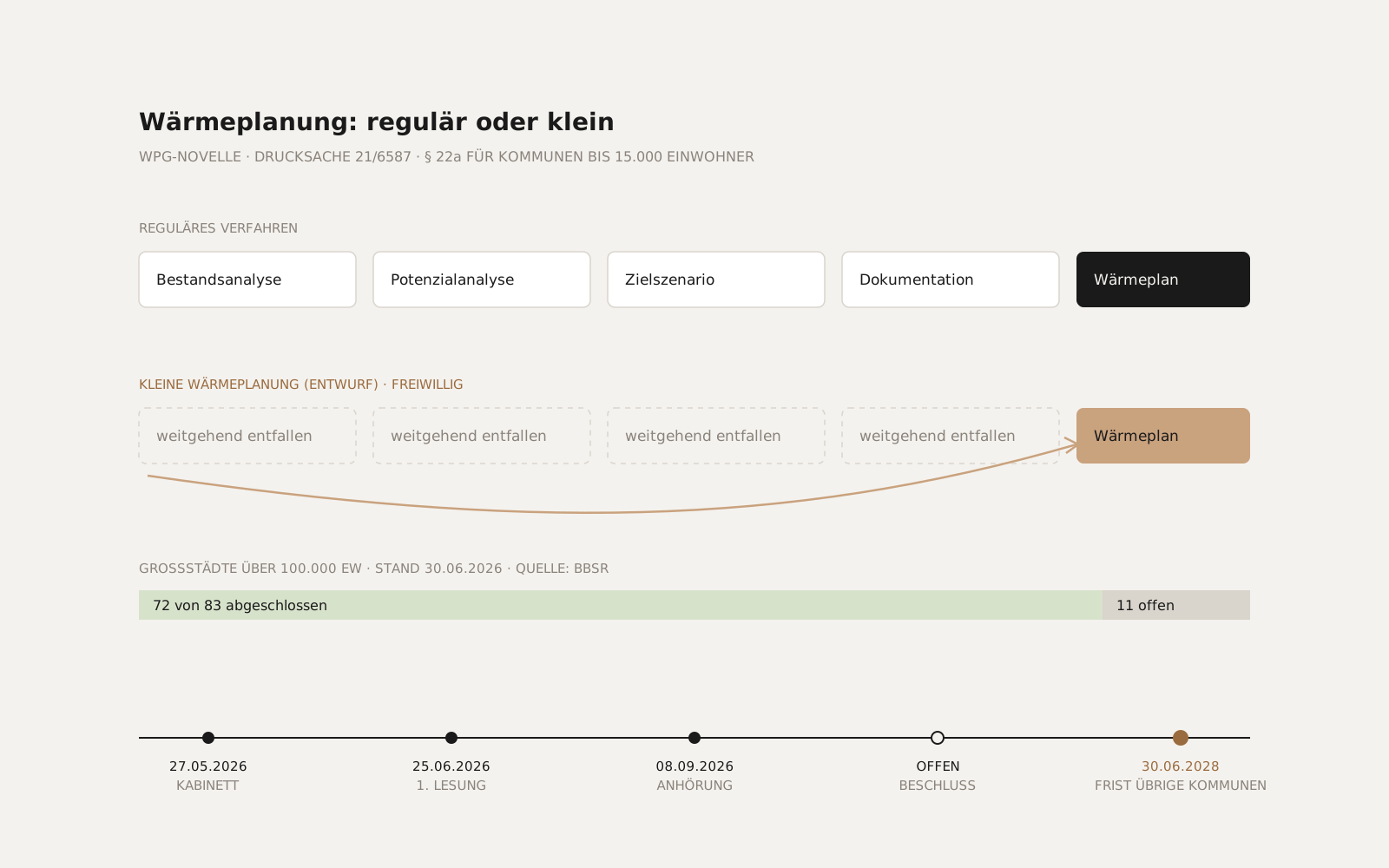
Municipalities with up to 15,000 inhabitants are to be allowed to draw up their heat plans in a much simpler procedure. This is part of the amendment to Germany's Heat Planning Act (WPG), adopted by the federal cabinet on 27 May 2026. The Bundestag held the first reading on 25 June 2026, followed by a hearing on 8 September. The amendment has not been passed yet. Many small municipalities therefore face a choice between starting now and waiting for the new procedure.
Which deadlines apply today?
Under current law, cities with more than 100,000 inhabitants had to present their heat plans by 30 June 2026. All other municipalities have until 30 June 2028. This second deadline covers the vast majority of municipalities, many of them very small.
How far are the large cities?
The first deadline gives a hint of how well the current procedure works. According to the half-year report of the Federal Institute for Research on Building, Urban Affairs and Spatial Development (BBSR), 72 of 83 cities with more than 100,000 inhabitants had completed their heat planning by 30 June 2026. The BBSR expects most of the rest to follow during 2026. If large cities with their own specialist departments and municipal utilities see delays, the pressure on small municipalities with few staff is all the greater. That is where small-scale heat planning comes in.
What is "small-scale heat planning"?
The draft (Bundestag printed paper 21/6587) adds a new section 22a with a small-scale heat planning procedure for municipalities with up to 15,000 inhabitants. According to the Bundestag, the procedure is optional: municipalities decide for themselves whether to use it. No implementation by the federal states is required. In the cabinet version, the inventory and potential analyses, the development of target scenarios and extensive documentation are largely dropped. Effort and duration are meant to fall significantly.
What else changes?
The building ministry names two further points. Collecting the data needed for heat planning is to be simplified while protecting personal data. The amendment also implements European requirements on cooling planning. According to an analysis by the law firm Becker Büttner Held, municipalities with more than 45,000 inhabitants would then also have to plan their cooling supply, in a much simpler procedure than for heat.
What applies to buildings in parallel?
Building law has already changed, independently of the WPG amendment. According to the federal government, the Bundestag and Bundesrat passed the amendment to the Buildings Energy Act in July. It is now called the Building Modernisation Act, was published in the Federal Law Gazette on 28 July 2026, and its main new rules have applied since 29 July 2026. Municipalities should therefore align their heat planning with current building law rather than older guidance.
What do the experts say?
At the hearing of the Committee on Economic Affairs and Energy on 8 September 2026, a majority of experts saw a clear need for changes, according to the Bundestag. They called for solid cost planning, reliable project management and a comprehensive funding strategy. One expert welcomed the choice between the regular procedure, the simplified procedure under state law and small-scale heat planning, and wanted it kept. The chemical industry association VCI asked for industrial process steam networks to be excluded from the scope.
Wait or start?
Until the amendment is passed, current law applies. According to an overview from late October 2026, it had not been passed by then. For small municipalities there is a good case for building the data basis now. Small-scale heat planning also needs a picture of which buildings stand where, where heat demand is high and where networks could pay off. That work is useful whichever procedure applies in the end.
In practice
Three steps help small municipalities now. First, check whether they fall under the 15,000-inhabitant threshold and follow the legislative process. Second, collect existing data, for example from the land register, chimney sweep records and grid operators, and name the gaps. Third, follow the changes requested at the hearing, because details of small-scale heat planning may still change. Area-wide satellite data can provide building stock, surface sealing and heat patterns for the whole municipality without site visits. SOLAIN prepares such data for heat planning and climate adaptation.
Sources
- German Bundestag: law on heat planning for small municipalities debated, 25 June 2026
- German Bundestag: hib, amendment to the Heat Planning Act
- German Bundestag: hib 691/2026, experts call for more planning certainty in heat planning
- German Bundestag: agenda of the hearing on 8 September 2026
- BMWSB: amendment to the Heat Planning Act
- baulinks: federal cabinet adopts Heat Planning Act amendment
- Becker Büttner Held: municipal cooling planning in the small WPG amendment
- Energie & Management: experts see need for changes in heat planning
- enerdomo: municipal heat planning, deadlines and consequences (as of October 2026)
- 42watt: municipal heat planning, deadlines and duties 2026
- Federal Government: new Building Modernisation Act
- Architekturblatt: municipal heat planning, BBSR half-year report (72 of 83 large cities)