Funding Climate Adaptation: Which Federal Programmes Municipalities and Social Facilities Can Use Now
Social facilities can apply for federal funding to implement climate adaptation measures until 30 November 2026, and the 2026 selection for the federal KlimaRäume programme is pending. Both programmes require municipalities to show where action is needed.
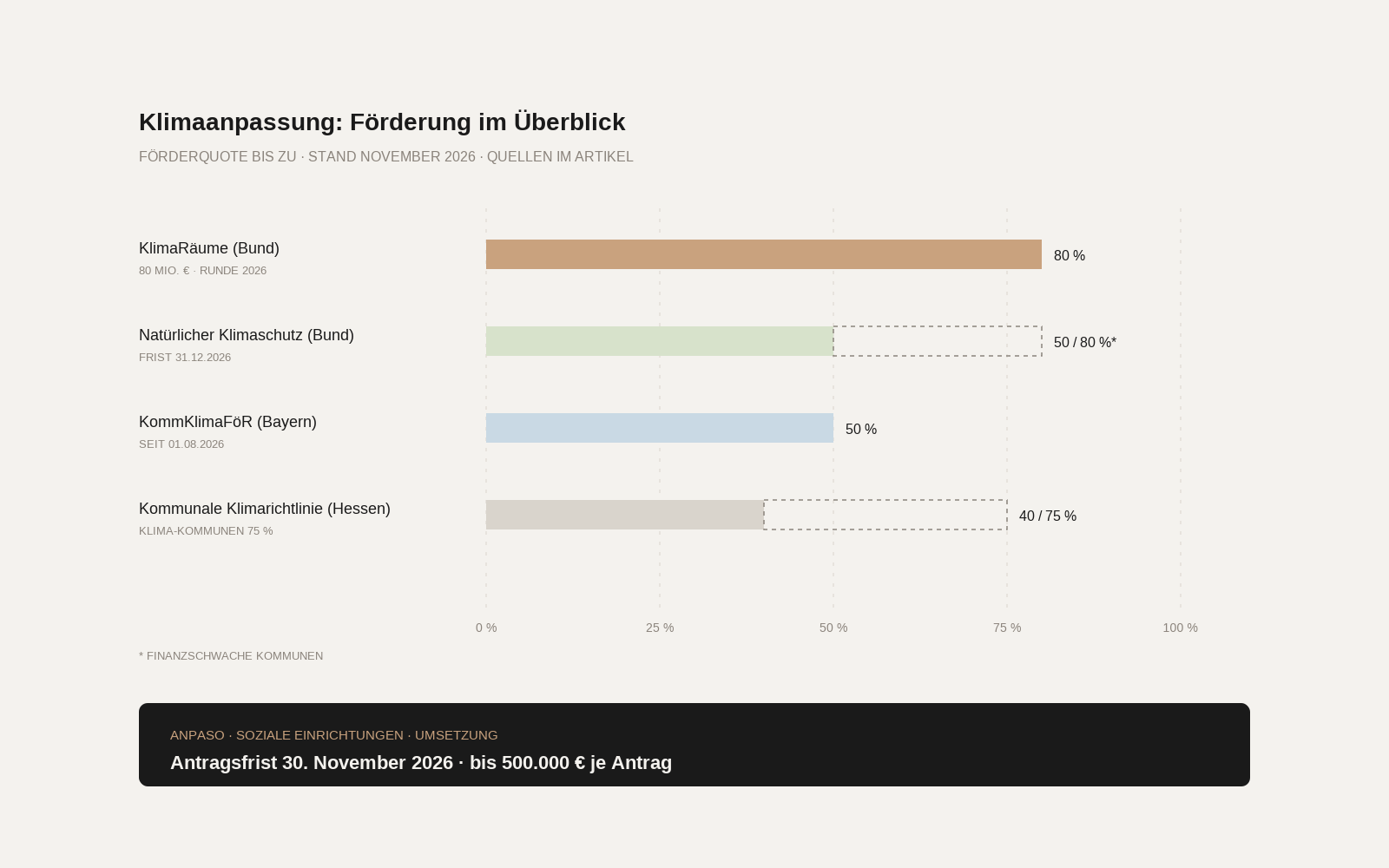
A federal funding window for climate adaptation closes on 30 November 2026. Until then, social facilities can apply for money to implement measures, provided they have already had a funded concept or advisory session. At the same time, the selection of projects from the 2026 round of the federal programme "Adapting urban and rural areas to climate change" (KlimaRäume) is pending. For municipalities and operators, it is a good moment to check their own groundwork.
What applies in the window until 30 November?
The environment ministry's programme "Climate adaptation in social facilities" (AnpaSo) is open from 1 October to 30 November 2026, according to the project agency ZUG. The deadline applies to the application, not to the start of construction. It funds follow-up projects, meaning the implementation of measures. Eligible are facilities that already received funding for a climate adaptation concept or an initial advisory session in the 2020, 2023 or 2024 windows. Each application can receive up to 500,000 euros. ZUG sends the direct application link by email to eligible earlier grant recipients.
How does the 2026 KlimaRäume round work?
According to the federal programme portal, KlimaRäume is the federal government's main investment programme for blue-green infrastructure in municipalities. So far, 656 million euros have been provided for it from the Climate and Transformation Fund. According to the BBSR, the fifth round started on 1 April 2026 with 80 million euros. Project outlines were due by 30 June 2026. Funded measures include new or upgraded green spaces, removing sealed surfaces and rainwater retention. According to DSK, the federal government usually covers up to 80 percent of costs. The Bundestag's budget committee decides which projects are funded.
Which other programmes exist?
Beyond these two, there are further funding pots with different rates. According to the federal environment ministry, the federal programme "Natural climate protection in municipalities" funds 50 percent, and financially weak municipalities receive 80 percent; the programme page gives 31 December 2026 as the application deadline. Bavaria has relaunched its municipal climate protection funding guideline (KommKlimaFöR): according to C.A.R.M.E.N., it has applied since 1 August 2026, also covers climate adaptation and pays up to 50 percent depending on the measure, with more for small and financially weak municipalities. In Hesse, "climate municipalities" currently receive 75 percent under the municipal climate guideline and all others a base rate of 40 percent. It is worth checking the current guideline before every application, as rates and deadlines change.
Why do municipalities need data anyway?
The Federal Climate Adaptation Act (KAnG) entered into force on 1 July 2024. It requires the federal states to present their own adaptation strategies and to ensure that climate adaptation concepts are drawn up for municipalities and districts. Under section 12, the states decide which bodies prepare these concepts, and for small municipalities they can refer to a district-level concept. According to the environment ministry, the states have reported progress to the federal government every two years since 30 September 2024, which also shows which municipalities already have a concept. North Rhine-Westphalia shows what this can look like in practice: it makes adaptation concepts mandatory from 2027. A concept needs a solid basis: where does heat build up, where is the ground sealed, where do particularly vulnerable people live?
What role do the federal programmes play?
Both programmes reward groundwork. For AnpaSo, an earlier concept or advisory session is a precondition for implementation funding. For KlimaRäume, municipalities compete with project outlines for a limited budget. Those who can document heat stress, sealing and green cover for the whole municipality can justify their need more easily and later show what a measure achieved. Removing sealed surfaces and adding green space in particular can be compared well over several years.
In practice
For operators of social facilities: anyone funded in an earlier AnpaSo window should check by 30 November whether ZUG's invitation email has arrived, and submit the application. Municipalities that submitted an outline to KlimaRäume should follow the budget committee's decision and prepare for the next round. For everyone else, it pays to build a data basis on heat, sealing and green space now, one that serves both the KAnG concept and future funding applications. SOLAIN provides such data from satellite observation for the whole area, comparable across years.
Sources
- ZUG: AnpaSo, information event on the 2026 funding call
- BMUKN: funding from October for climate adaptation in social facilities
- BMUKN: programme climate adaptation in social facilities
- Der Paritätische: new funding call for follow-up projects
- Federal programme portal: adapting urban and rural areas to climate change
- BBSR: new funding round of the federal programme launched
- DSK: KlimaRäume call 2026, 80 million euros for municipalities
- Energy Agency Rhineland-Palatinate: call for adapting urban and rural areas
- Gesetze im Internet: Federal Climate Adaptation Act (KAnG)
- BMUKN: FAQ on the Climate Adaptation Act
- BMUKN: Natural climate protection in municipalities
- C.A.R.M.E.N.: new KommKlimaFöR 2026 in Bavaria
- Hesse ministry: municipal climate guideline
- SOLAIN: NRW makes climate adaptation concepts mandatory